


Setting is a story element that must do double duty in any genre: it’s your backdrop, so it shouldn’t take over and become the story, but it should be chosen deliberately and used to both enrich and amplify your scenes. It should blend in and be influential.
But this is especially true in mystery novels where the setting can limit suspects, suggest motives, provide clues, and shape the crime. So, let’s look at some different options for setting in mysteries.
The Locked Room
Using a locked room as a crime scene creates a seemingly unsolvable mystery that will flummox everyone (including most readers) and allow your detective to emerge as the brilliant sleuth who sees what others do not. Edgar Allan Poe was the first to use this type of setting in Murders in the Rue Morgue, where two murders are committed in a room locked from the inside with no apparent way for the murderer to escape. Arthur Conan Doyle also used it in The Speckled Band.
As the author, you’re expected to give readers enough clues that they can play detective alongside the protagonist and solve the mystery themselves. That’s the draw of these stories. Readers want to try their hand at finding the solution, but they also want to see the detective best everyone.
However, most novels and stories that are referred to as locked room mysteries are in fact closed circles.
The Closed Circle
Think Soldier Island, in Agatha Christie’s And Then There Were None or the stalled train in Murder on the Orient Express. These are closed-circle mysteries in which the crimes occur among a limited, isolated group of people, with no one else coming or going—one of whom must be the murderer. The limited setting creates great psychological pressure because everyone becomes a suspect, and the group is trapped together in one form or another… with the murderer. This means they all become paranoid, fearful and nervous, emotions authors can use to amplify an already stressful situation.
For this to work, however, the circle really must be closed. The setting must be truly isolated so that no one new can enter. A number of the characters should also have plausible motives for being the murderer, as well as some opportunity to commit the crime, so that the detective (and the reader) can’t easily cross anyone off their list of suspects.
And there’s that delicate balance to achieve between making it seem unsolvable but also giving readers the chance to figure it out. If they have no chance, they’ll feel cheated. If it’s too easy, they won’t read on.
A closed system means there’s only a limited number of possibilities. Someone in the isolated location is the murderer. But it’s not the only way to go in mysteries.
Needle in a Haystack
In Patricia Cornwell’s Postmortem, Kay Scarpetta and Pete Marino are looking for a serial killer in Richmond, Virginia. The killer might not even live there. They might have taken off. Throwing the doors open like this on your setting creates a different kind of stress on the reader. The killer is at large. They could be the person you ride the bus with every morning. They could be a coworker. And when they could be anywhere, the possibility of tracking them down feels monumental. The setting itself creates that panicky feeling these types of novels depend on for suspense.
Open systems create a greater possibility for both complexity and corruption. A lot can go wrong when you’re chasing someone in a city. There’s traffic. A person you’re following can give you the slip. There’s rivalry within departments and systems that can prevent a case from being solved.
But even in an open system, you still have choices.
Noir versus Cozy
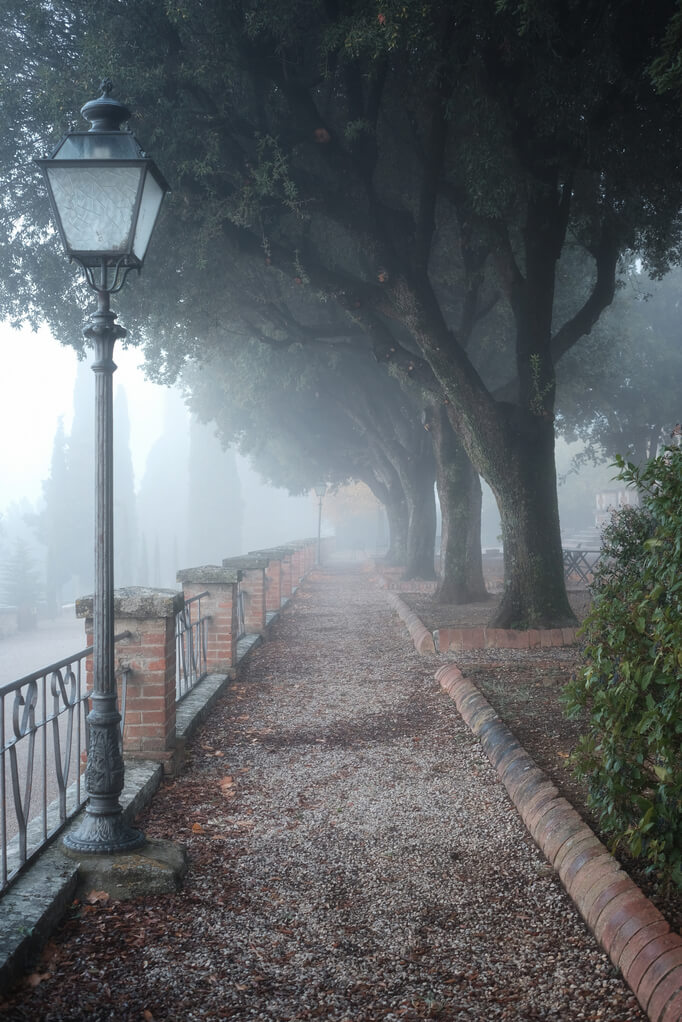
Comparing noir and cozy mysteries is a great way to see how impactful setting can be in a novel. The noir subgenre features a gritty urban setting where corruption is rife, and no one can be trusted. You want weather? Think rain. Fog. Darkness. Rooms? Think smoky bars, shadowy back alleys. You can’t trust anyone to do the right thing, so cynicism and disillusionment are the order of the day. The streets are violent, and the violence is often graphically portrayed.
A cozy mystery is more likely to take place in a village or small town known for its quirky charm where everyone knows each other and there’s probably a bookshop with a cat in it. The tone is gentle, and the violence takes place offstage. The murder represents a disruption to the status quo rather than just another Tuesday in Baltimore. Cozy mysteries usually feature an amateur sleuth, as opposed to the hard-boiled PI who doesn’t get along with anyone.
Setting Amplifiers
Many aspects of setting can amplify a situation and heighten tension. Weather is one of them. In Postmortem, Patricia Cornwell made the summer particularly hot while the serial killer was on the loose. Why? Because hot summer evenings mean people are more inclined to leave their windows open.
Agatha Christie uses the weather in And Then There Were None to isolate Soldier Island: a storm means no one can get there to offer help—and no one can leave. A snowbank stops the Orient Express in its tracks. Snow also means someone will leave tracks behind, making it harder for a murderer to escape without leaving clues.
What’s key here is that your choices matter. If you set your novel on a cruise ship, boat-related plot points must play into the story—otherwise, why set it there? Ditto if you set it in a different historical era—like in The Name of the Rose by Umberto Eco. If the history doesn’t impact the mystery, then you’re not using your setting to its full potential—and your choice will be confusing. Readers assume every decision an author makes is intentional—especially in a mystery where every small detail might be a clue.
The Place Shapes the Crime
This is another consideration for the choices you make about setting. A small-town murder won’t feel the same as a political assassination. The crimes themselves should be impacted by where they take place. There’s a lot of wiggle room here because incongruity can work in your favor—as long as you recognize it and use it.
Location, Location, Location
Setting is “only” the backdrop, but in a mystery it’s also the crime scene which makes it a key element of your story. Choose your setting wisely, and once you’ve chosen it, use it to its full potential. Make the setting work in your favor so that it amplifies the tension of your scenes and creates obstacles for your characters.
Quick Recap: Setting is important in any genre but doubly so in mysteries where it can limit suspects, suggest motives, provide clues, and shape the crime. This post shows the different types of settings in mysteries and how they can amplify tension.
Harness the power of the setting with The Rural Setting Thesaurus and The Urban Setting Thesaurus.

Part how-to, part brainstorming tool, they’re like a masterclass in maximizing your setting. Access sights, sounds, smells, tastes, and textures of 100+ natural and personal locations or over 120 modern locations.
These books will help you:
- Immerse Readers in the Story
- Add Depth and Mood
- Generate Realistic Conflict in the Perfect Locations
- Use Setting to Shape Plot
- Utilize Figurative Language for Powerful, Layered Descriptions. Repurpose descriptive details as metaphors that add layers of meaning and stir the reader’s emotions.








16 Comments.
With these posts, I love to see how my stories fit the model. My wife and I wrote a ghost story/murder mystery/romance set in 1890s England. An English barrister and his housemaid–who dislike each other–have to solve the 60-year old murder of a woman whose ghost now haunts the country estate. Small village, superstitious villagers, tarot readers, and strange dreams. Clues gradually emerge. So does romance.
How fun! That sounds wonderful. Great setting for a ghost story/mystery.
I don’t write mysteries, but I love seeing how the universal story elements can be used strategically in certain genres. I think this will come in handy for our mystery writers. Thank you, Michelle!
Yes, there are interesting variations and ways in which familiar elements like setting can be used to a writer’s advantage.
Thanks so much for this amazing post, Michelle. I haven’t written a mystery yet, but I have a critique partner with one and this will help me give stronger feedback. 🙂
Oh , that’s awesome. I’m glad this is helpful. David Brown and I are working on a new book of mystery skeletons, so we’ve been delving into structure and I’ve learned a lot about the various subgenres and how mysteries get built. Super fun!
That’s fantastic, Michelle! Any idea when your new book of mystery skeletons will be available?
I love how your research helps so many writers with your book and amazing posts, like this one. 🙂
Thank you! The book should be available sometime next year.
Also, apologies, all. The editor (I mean me) misspelled a word. It’s The Murders in the Rue MORGUE. Ugh. Sorry.
Fixed!!
Thank you!
Gosh, this title alone brought back so many good memories for me! Such a great post, and not just for mystery writers! The setting is such a great tool for directing the emotions of readers and characters, through ambiance, symbolism, location-specific tension, etc. So worth the time to get specific and make specific choices to power the scene and push the story forward.
Thanks, Angela. Everyone loves Clue! And I’m a huge fan of the power of setting. I could talk about it for hours. It can do so much to create an immersive scene.
I wrote a children’s book that loosely used this concept. lol
Dear Michelle,
Excellent post on setting. It was the perfect succinct summary of all types of setting/mysteries.
On a side note, I’ve just finished a YA murder mystery novel set in a high school theater where the plot unfolds under the umbrella of the play Clue. And yes, one of the possible suspects is one of the kids who plays Colonel Mustard.
Too funny.
Thanks for keeping us focused, informed and motivated!
All my best,
Matt
Ha, love it! Thank you for the kind words.
Your book sounds great 🙂