


Conflict in every scene.
It’s popular advice because it’s true. Conflict ratchets up the tension for readers because it makes the character’s success less likely, and readers start worrying about the hero’s ability to win. Will she find true love? Can he overcome his demons and move forward into fulfillment?
Conflict is also desirable because of the emotions it stirs. To engage readers, you have to engage their feelings, and a surefire way to do this is to threaten, humiliate, undermine, or sabotage the protagonist they’ve come to know and love. This is where emotion amplifiers can be especially useful.
An emotion amplifier is a specific state or condition that influences what the character feels by disrupting their equilibrium and reducing their ability to think critically.
If you’ve done your job as the author, your character’s journey will be difficult enough. But add an amplifier like illness, pain, sensory overload, or burnout, and their situation becomes more tenuous. As the character’s volatility rises, their ability to think clearly and rationally drops. The result? Mistakes and mishaps that push them farther from their goal. And readers who feel their pain because they’ve been there and have experienced those same uncomfortable emotions.
So amplifiers are great vehicles for providing the conflict that will further your story and propel the protagonist along their character arc. Which is handy, because if every scene must have meaningful conflict, you’ll need a lot of it to get the character from Page One to The End.
That being said, there are times when struggle and strife will actually get in your way. Here are 4 key story moments when it’s best to hold the conflict.
1. The Resolution Phase of a Scene or Plot Line
Successful stories have a clearly defined beginning, middle, and end. The same formula applies to strong scenes.
The beginning of a scene is an opportunity to show the scene goal, the thing the character is hoping to do that moves them toward their overall objective.
But then conflict arrives in the form of obstacles, adversaries, or dilemmas; the middle of the scene is dedicated to the wrestling match with that conflict. (This is the perfect place for amplifiers to augment tension and complications.)
The end of the scene shows whether the character is successful in reaching their goal. Hint: most of the time, they aren’t.
A visual image of the tension in a scene might look something like this:

Tension rises as the protagonist encounters conflict that makes it more difficult to get what they want. After a prolonged climb, the tension reaches a peak before dropping off as the scene is resolved and comes to an end.
New conflict applied during the end stage would ramp things up again, delaying the resolution. But this is the time to de-escalate the situation, not fan the flames. Once you reach this point in the scene, resist the urge to add conflict and or any amplifiers.
But what about cliffhangers? you ask. Half the chapters I read end with serious conflict, high tension, and a character smack in the middle of a sticky situation.
Ah, but in this case, you’re talking about chapters, not scenes. While the two terms are often used interchangeably, they’re not the same.
Scenes are the basic building blocks of a story. Every scene should follow a defined structure, and the scene is not complete until all the elements have been included. The arc above is a visual representation of that structure.
Chapters, on the other hand, are used to divide the story into manageable chunks for readers. Rather than adhering to a certain structure, the end of each chapter is arbitrarily determined by the author, a choice that depends largely on style.
A chapter might encompass a complete scene, or it might end in the middle of one. In the latter case, the chapter could end with high tension because it hasn’t yet reached the end of the scene. Ending a chapter at this point often results in a cliffhanger, and there are good reasons to do that. But conflict should be avoided at the completion of a scene, whether it coincides with the end of a chapter or not.
2. In Revelatory Moments
As characters trudge along in their growth journey, you’ll be throwing every difficult thing imaginable at them. In the beginning, they won’t respond well because they’re stuck in their old dysfunctional, ineffective habits. But as the story progresses, they’ll experience periods of introspection (often following a big event) that lead to a light-bulb revelation. They’ll realize they’ve been believing a lie, or the shielding behavior they thought was a strength is their greatest weakness and is holding them back. These moments of clarity push the protagonist to rethink their methods and make much-needed changes that help them succeed.
At times like these, characters need to be thinking clearly. If their thoughts are fogged by an amplifier like arousal, intoxication, or exhaustion, the likelihood that they’ll come to a logical conclusion is low. Save amplifiers and conflict for the events that lead to these introspective interludes and you’ll put your characters in the strongest position to become self-aware and embrace change.
3. During Zen Times

If you’re doing your job as the author, the protagonist will spend a lot of time frustrated, angry, afraid, or uncertain. Amplifiers are great for creating situations that escalate to those emotions.
But a story in which the protagonist is always emotionally activated can grow tiresome for readers. It will also lessen the character’s authenticity because they’re unable to experience a complete range of feelings.
Since amplifiers and conflict influence a character’s emotions and make them more volatile, they’re not so effective at eliciting relaxation and inner peace. When the protagonist needs to be chill, hold the conflict.
4. When a Character Can’t Take Any More
Authenticity is crucial when writing realistic characters. In every way possible—their motivations, fears, flaws, strengths, quirks, and so on—characters should imitate real people. Just as we each have our own breaking points, your characters have theirs, too.
So how far is too far? This often becomes obvious during drafting. As you continue abusing the protagonist, you’ll realize you’ve crossed a line or are close to doing so. Critique partners will also let you know when things have gone on long enough. Either way, that’s the time to stop. Drive the protagonist right to their breaking point, but stop short of pushing them past it.
Conflict and tension are vital pieces to a successful story puzzle, so it’s necessary to keep turning up the heat on our characters. The moments discussed above are good examples of times when conflict and amplifiers can work against the story. Leave them in the toolbox until the right moments so they can do what they need to at the right time.
Can you think of other times in the story when conflict hinders instead of helps?
When you want to amp up your conflict, check out A Mother Lode of Resources on Emotion Amplifiers
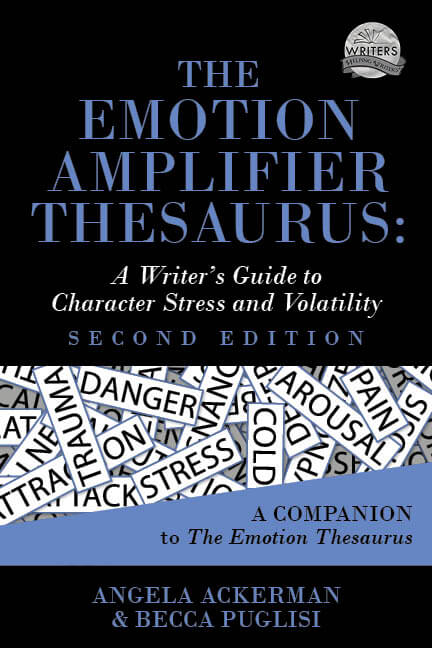
When emotions spiral, characters make mistakes—and that’s where great storytelling happens.
The Emotion Amplifier Thesaurus explores 52 states and conditions (like pain, hunger, and competition) that strip away self-control, heighten feelings, and push characters toward risky choices. Juice your story with tension, reveal your character’s hidden emotions, and craft high-stakes moments that drive both conflict and growth.






1 Comment.
Conflict is so important, I’ve read a lot of posts about adding it. But it’s also great to know when it helps to ease off the conflict for a bit. Thanks so much for this, Becca!
I think I have one more to add. You mentioned backing off the conflict when a character can’t take any more. I wonder if there might be times when a reader needs a brief break that might not happen at the same time as the character needing one. You mentioned critique partners letting you know, so maybe it’s already covered. 🙂