


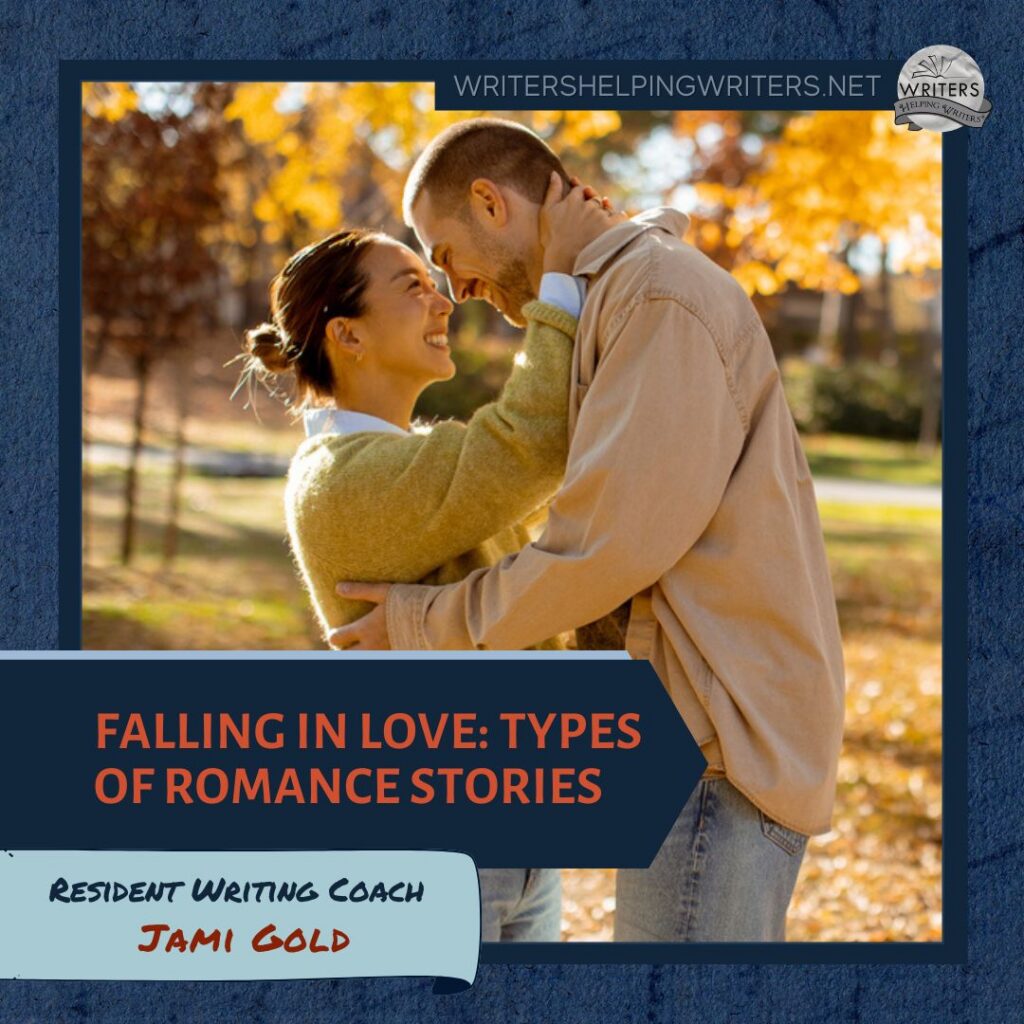
From subgenres to tropes and beyond, there are many ways to categorize a romance story. We may not know exactly what type of story we’re writing while drafting (especially if we tend to write by the seat of our pants), but once we type “The End,” we do need to figure out what we’ve created.
First, subgenres, tropes, level of spice, etc. all come with various reader expectations, and we need to meet those expectations to earn reader approval. Second, those same categories all have fans among readers, and the best way to find romance readers who will love our story is to allude to those details with our marketing.
So how can we know what descriptions and categories apply to our story? Let’s look at the types of romance stories at every level.
Category Type #1: Identify the Subgenre
The romance genre is huge, as it includes all stories centered on a romantic relationship that ends in a happy/optimistic way that leaves readers emotionally satisfied. Because of this scope, readers need to break the genre into smaller chunks to be able to find and share the types of stories they enjoy.
The first (and biggest) way to categorize romance stories is by subgenre. The various subgenres are the easiest way to call out “if you love subgenre, check out this story.”
Essentially, subgenres describe the world and worldbuilding of the story. For example, is the worldbuilding…?
- modern and real-world based? Contemporary Romance
- focused on supernatural/magical elements but otherwise feels like our world? Paranormal Romance
- set 50 years or more before modern-day? Historical Romance
- focused on mystery or thriller elements? Romantic Suspense
- centered on futuristic elements or set in space? Science Fiction Romance
- focused on fantasy elements and/or set in a different world? Fantasy Romance/Romantasy
- inclusive of LGBTQ+/queer elements? LGBTQ+ (or Queer) Romance
- centered on sexual elements? Erotic Romance
- focused on taboo or psychologically intense topics? Dark Romance
- focused on teenagers or first-loves? Young Adult (YA) Romance
- centered on becoming-an-independent-adult elements? New Adult (NA) Romance
Notes on Subgenre Overlap:
Some of these worldbuilding elements can overlap, as they’re non-exclusive (age-focused, sexual-orientation-focused, etc.) with other setting or story world details. So there’s not necessarily “one right way” to categorize our story.
For example, we could categorize LGBTQ+ stories in their own subgenre (Queer Romance) or use the general subgenre and mention the LGBTQ+ elements (Contemporary Romance with a bisexual hero). The same idea sometimes applies to other character traits (Black Romance vs. Contemporary Romance with Black characters).
One choice can make it easier for fans to find those stories, and the other option can be less “othering,” especially for historically marginalized traits. At the same time, there’s the possibility of a difference in expectations. For instance, an LGBTQ+ Romance might be expected by some readers to center the LGBTQ+ aspects of the story more than a whatever-subgenre romance with a queer main character.
In fact, we might market our book under one subgenre to some audiences and under a different subgenre to other audiences, such as a time-travel romance being marketed to paranormal-romance audiences vs. historical-romance audiences. Whatever our choice, we want to think about the expectations of our readers and how we can best categorize the subgenre of our story to find the readers who will love our creation.
Category Type #2: Identify the Tropes
Tropes are storytelling patterns. If readers recognize a pattern enough to think they know what to expect (even subconsciously), that’s a sign of it being a trope. That pattern recognition isn’t bad or negative, as tropes are just part of how we tell stories.
In fact, we can use them as shortcuts for readers to quickly understand or relate to the situation because they recognize the pattern. Then we can use the “saved” wordcount to show unique growth and development from that trope-pattern starting point.
In the romance genre, readers have favorite tropes because they enjoy seeing all the different ways that pattern can play out or be twisted in unexpected ways. The marketing for romance stories embraces tropes, so we need to know what patterns we’ve included in our creation.
A list of all tropes found in romance would be longer than this entire post, but a few common examples include (find more by searching for “romance trope list”):
- Meet-cute: They meet in a cute (or “adorkable”) way.
- Enemies-to-lovers: They start off as enemies/rivals.
- Friends-to-lovers: They start off as friends.
- Fake dating/relationship: They pretend to be a couple.
- Fated mates: They’re destined to be together.
- Forbidden love: They shouldn’t be together because…reasons.
- Opposites attract: They seem to have nothing in common.
- Grumpy/sunshine: They have opposite personalities.
- Secret identity: One isn’t who they seem/claim to be.
- Forced proximity: They’re forced to share space.
- Only one bed: They have to share a bed (a popular type of Forced Proximity).
- Love-at-first-sight: They feel attraction immediately.
- Slow-burn: They resist, deny, or otherwise develop the romance slowly (often to create depth).
- Second-chance: They try again after a breakup.
- Marriage of convenience: They get together for purely practical reasons.
Category Type #3: Identify the Vibes
“Vibes” refers to all the other elements that affect our storytelling, characters, subgenre/worldbuilding, and the romance relationship. Stories can share the same subgenre and tropes—and even the same overall story beats—and still be very different in implementation.
The implementation details we choose greatly alter our readers’ expectations. Think of how a Contemporary Romance with an “only one bed” trope would differ with small-town, slow-burn vibes versus spicy, snarky, quick-banter vibes.
With slow-burn vibes, the “only one bed” trope would likely play out with subtle (perhaps even subconscious) emotions of longing or attraction. Characters might be confused at their sense of awkwardness, for example. With spicy, banter-focused vibes, the trope would more likely lead to some type of sexual expression (even if just in the character’s thoughts).
In short, in a genre like mystery or romance, where the ending is a given, the implementation of how we get to that satisfying ending is everything. The journey we create for readers toward that ending is the story.
Vibes can include the implementation details of:
Storytelling:
Elements that affect our storytelling, such as:
- Tone/mood, style, and voice:
- comedic, serious, gritty, dark, eerie, light, epistolary, fairy-tale, romcom, snarky, etc.
- Plot and pacing:
- fast-paced, slowly builds to big finish, low-key, multi-book romance (may feature cliffhangers until the last book’s happy ending), etc.
- Emotions and depth of point-of-view:
- tense, sexy, angsty, cozy, dangerous, brooding, remote/mysterious, deeply visceral, etc.
- Use of minor characters:
- best friend helper or obstacle, matchmaker, charming side characters, villain/bad guys, etc.
Characters:
Elements that affect our characters, such as:

- Circumstances or elements inherent to the character:
- billionaire, BIPOC, LGBTQ+, royalty/famous/celebrity, tortured background, virgin, orphan, plus-sized, later-in-life, etc.
- Personality or values of the characters:
- bad boy/girl with a heart of gold, caretaker, protector, alpha/beta hero, cinnamon-role hero, grumpy/sunshine, etc.
- Perspective towards relationships:
- looking for love, sworn off relationships, been hurt before, pressured into dating, etc.
Subgenre/Worldbuilding:
Specific details for subgenre, settings, and worldbuilding:
- Sub-subgenres further break down romance subgenres, such as:
- Contemporary Romance: small-town, romcom, inspirational/religious, cowboy, sports, Christmas/holiday, etc.
- Paranormal Romance: vampire, shifters (werewolves, dragons, and the like), witches, angels, demons, etc.
- Historical Romance: Regency, Western/Old West, medieval, Viking, Asian dynasties, time-travel, gothic, etc.
- Worldbuilding choices (including values, beliefs, history, etc.), such as the different vibes created by a post-apocalyptic world with:
- survival-of-the-fittest rules vs. we’re-rebuilding-a-better-world ideals
- the “known” history of the world is accurate vs. it’s all a big lie
- people are inherently valued vs. people are seen as expendable
Romance Relationship:
Elements that affect the relationship and growth of the romance, such as:
- Type of romance (many of these have developed into popular tropes):
- slow-burn, fated mates, love at first sight, forbidden, second-chance, blind date, etc.
- Type of relationship:
- hetero, interracial/multicultural, LGBTQ+/queer, love triangle, 3+/why choose, etc.
- Type of interactions:
- workplace, banter-focused, power-play dynamics, shy, toxic, caregiving, etc.
- Spice/sexiness level:
- sweet/wholesome, slow burn grows into spicy hot, spicy/open door, kinky, etc.
Final Thoughts: Reader Expectations
So how do we know what reader expectations are for each of those categories? The answer to that question would be a Ph.D.-level research paper, as each subgenre, trope, and vibe comes with different reader expectations.
The best way to learn about the reader expectations of romance story elements is to be a voracious reader in the genre. Then we’ll see and experience what works or doesn’t, what falls flat, or what causes subtextual conflicts, etc. And if we’re still not sure about the categories that define our story, we can also reach out to our beta readers or early readers and ask how they’d describe or categorize our book.
Want to dig deeper into this topic (exploring subtext and weaknesses of romance elements)? Check out Jami’s companion post!
Finally, we could obviously come up with many more examples for each of the bullet-point lists above, which just illustrates why the romance genre needs marketing to find readers who will love a specific type of story. The genre is so huge that to find our readers, we must learn how to categorize our story. But if we use the right descriptions to appeal to those with the right expectations, our readers will find us and our stories. *smile*
Have you struggled with how to describe your romance story? Or have you thought about writing a romance and didn’t know where to start to break into the huge genre? Do these categories help you better understand your story and marketing options? Do you have any questions about how to categorize your romance story?
Summary for Busy Writers: The romance genre is huge, so to find the readers who will have their expectations met and love our writing choices, we need to know how to categorize and define our story through subgenres, tropes, and the many other elements that affect our storytelling. This post helps us learn how to describe our story—and thus find our readers.





8 Comments.
Just discovered this blog, and its a breath of fresh air! This has helped a ton in my writing!
Thanks again for having me here, Becca and Angela! Always a treat to share with your readers. 🙂
What a great breakdown—and no small task. The romance genre is sprawling and covers so much. And fans tend to be very loyal to their preferred subgenres, so figuring that out for marketing purposes really is huge.
Hi Becca,
As you said, it really is important to figure out our story’s description! Of course the reason I had to learn all this is because I’ve written several stories that don’t fit neatly into the usual categories–lol.
I like also the other „second chance” possibility – there has to be, sometimes, a second chance to love for the one who was not chosen (one of the sequels of a love triangle), even if with someone else. Healing from love and finding another love is also a heartwarming story!
Hi Marina,
Ooo, yes, good catch! Sometimes the “second chance at love” label can refer to slightly different situations. As you mentioned, sometimes it isn’t about the second chance for a specific relationship but about a character’s second chance at finding happiness after something took their earlier happiness away.
Obviously, our story’s blurb can make clear what type of “second chance” our story depicts, but it’s great to point out the options. Thanks for the great comment!
I enjoy writing stories featuring healing from love.
Great post, Jami!
Hi, Jennifer,
Yes, I’m not sure if this is exactly the same, but it sounds similar to the Hurt/Comfort trope, which has grown from being a very popular tag in fanfic spaces. Thanks for sharing!