

Three Ways to Make Readers Care About Secondary Characters

Three Ways to Make Readers Care About Secondary Characters
A common mistake I see in client manuscripts is a cast of secondary characters that simply exist to help or to outright block the protagonist. They’re either ready, willing, and…
Read more…Writing Flawed Characters Who Don’t Turn Readers Off

Writing Flawed Characters Who Don’t Turn Readers Off
No one in the real world is perfect, and so characters shouldn’t be either. To seem as real as you or me, they should have flaws and strengths, and these…
Read more…Writing About Pain: Invisible Injuries and Conditions

Writing About Pain: Invisible Injuries and Conditions
In this series on pain, we’ve covered everything from minor injuries to major and mortal injuries. But there’s another source of pain that can push our characters to the edge…
Read more…Character Type & Trope Thesaurus: Christ Figure
Character Type & Trope Thesaurus: Christ Figure
In 1959, Carl Jung first popularized the idea of archetypes—”universal images that have existed since the remotest times.” He posited that every person is a blend of these 12 basic…
Read more…Writing about Pain: Describing Major & Mortal Injuries

Writing about Pain: Describing Major & Mortal Injuries
As you may be aware, we’re smack dab in the middle of a series of posts on writing a character’s pain, and today’s is a doozy. Our last post explored…
Read more…Writing About Pain: Three Stages of Awareness

Writing About Pain: Three Stages of Awareness
If there’s one thing writers like to do, it’s to make characters suffer. We are all about bringing forth pain and crises, whether it be emotional, physical, spiritual, or existential.…
Read more…How to Stay Focused on Your Story’s Central Conflict
How to Stay Focused on Your Story’s Central Conflict
Conflict in every scene. We’ve all heard this advice, and for good reason. Your protagonist has a goal—hopefully, an audacious and high-stakes goal that is difficult to achieve. “Difficult” is…
Read more…After the First Draft: Revising Your Plot
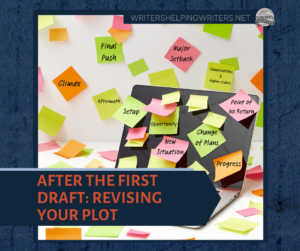
After the First Draft: Revising Your Plot
Ok, writers. Raise your hand if you love revising. *crickets* Revision freaks a lot of people out because it can be overwhelming. When you start drafting, you’ve got this really…
Read more…Keep Tensions High by NOT Resolving Your Character’s Relationship Conflict

Keep Tensions High by NOT Resolving Your Character’s Relationship Conflict
When it comes to story conflict, there are so many options to choose from. Power struggles, physical threats, moral dilemmas, failures, ticking clocks—they’re all great for ratcheting up tension, building…
Read more…Do Your Characters Have Agency?
Do Your Characters Have Agency?
Consider, if you will, a story about a woman who wants to gain esteem by winning an important legal case. Things are going along fine until she gets fired from…
Read more…Adversarial Conflict: Who Is Making Trouble In Your Story?

Adversarial Conflict: Who Is Making Trouble In Your Story?
Is there anything better than well-written conflict? The vengeful enemy, sharks circling a sinking boat, a carefully guarded secret getting out in the open. Readers, fearful for the characters they…
Read more…Does Your Story Need a Hit of Organic Conflict? Look to Your Setting.

Does Your Story Need a Hit of Organic Conflict? Look to Your Setting.
Every writer’s mission is to pen a story that draws readers in, offering familiarity when it comes to certain genre expectations while also delivering something fresh so to be distinctive…
Read more…



Comments are closed.