


A cardinal sin of storytelling is to skimp on conflict, and no wonder. Those problems, challenges, obstacles, and inner struggles help keep readers engaged, casting doubt on the character’s ability to achieve their goal.
Because readers are focused on what’s happening from one scene to the next, it can appear that conflict is only occurring moment to moment. It’s actually present at different levels in the story, not just at the scene level. Understanding the levels of conflict and how various challenges will interact is key to building a rich, powerful story, so let’s dive in.
Level 1: Central Conflict
Every story will have an overarching conflict that should be resolved by the end of the book. Whether your protagonist is trying to prevent evil creatures from entering their world (Stranger Things), stop the terrorists who have taken over Nakatomi Tower (Die Hard), or find the groom and get him to his wedding on time (The Hangover), they must address that problem. The central conflict for any story will take one of six forms:
- Character vs. Character: The protagonist goes up against another character in a battle of wits, will, and strength.
- Character vs. Society: The protagonist takes on society or an agency within it to bring about necessary change.
- Character vs. Nature: The protagonist battles a form of nature, such as the weather, a challenging landscape, or its animal inhabitants.
- Character vs. Technology: The protagonist faces a manufactured foe, such as a computer or machine.
- Character vs. Supernatural: The protagonist confronts a force that exists outside their full understanding. This may involve an encounter with fate, a god, or some other magical or spiritual foe.
- Character vs. Self: The protagonist experiences a large-scale internal battle of clashing beliefs, hopes, needs, or fears.
The central conflict locks the wheels of your story’s roller coaster onto a specific track so the macro and micro challenges you add will support plot and character development.
Level 2: Story-Level (Macro) Conflict
Some conflicts present bigger problems that your character doesn’t have the means or ability to solve. These threats loom over much of the story, and the protagonist will have to work through them while handling other immediate, scene-level dangers and challenges.
For example, in Die Hard, John McClane is one man against an organized, armed group who have taken over Nakatomi Tower. His central conflict (character vs. character) is to stop the terrorists and save everyone in the building, especially his wife. That on its own seems impossible, but it’s complicated by a few other problems he also must deal with: keeping Holly’s identity as his wife a secret so the terrorists can’t use her as leverage, figuring out Hans Gruber’s real motive for taking over the tower, and doing it all despite the bungling interference of a grossly inept FBI.
And in the back of his mind is the most challenging problem of all, the one that brought him to California in the first place: how to fix his crumbling marriage and reconcile with Holly before it’s too late.
Large-scale conflicts like these will need to be addressed by your protagonist, but they won’t be ironed out immediately. Very often, the character will have to work on these issues in stages as they dodge danger and achieve smaller goals from scene to scene.
Level 3: Scene-Level (Micro) Conflict
Conflict at the scene level comes in the form of as-it-happens clashes, threats, obstacles, and challenges that get between your character and their goal. The character is trying to handle what’s right in front of them, deal with inner struggles, and above all else, prevent disaster.
Sometimes they succeed and sometimes they fail—and failure is part of the process, by the way. Setbacks are necessary to increase the pressure, introduce complications, raise the stakes, and force your character to examine why things went wrong. This last one is especially important for characters on a change arc since internal growth is crucial for them to successfully achieve their story goal.
In Die Hard, John McClane pulls the fire alarm so first responders will arrive and discover what’s going on in the tower. This fails when the terrorists convince the fire department it was a false alarm. Worse, it places a target on John’s back because now Hans Gruber and his mercenaries know that someone in the building is working against them. A manhunt results with John, unarmed and barefoot, fighting to stay a step ahead in each scene by outwitting, overpowering, and killing those sent to eliminate him.
Level 4: Internal Conflict
Another form of conflict takes place within the character. At the macro level, it’s the main internal struggle the protagonist must address to achieve their story goal.
John McClane’s marriage is a breath away from breaking because he’s self-absorbed and unaccommodating, believing his needs and career should come first. Holly, rather than become a minimized puzzle piece in John’s world, moves herself and their children across the country to follow her own professional dream. John visits her with the goal of reconciling, but he’s really hoping that her choices have shown her she’s better off in New York with him. Instead, he finds her happy, thriving in her career, and independent—so independent, she’s using her maiden name.
This ego hit makes John realize that getting her back won’t be easy, and if he wants to make it work, he might have to make some sacrifices. This sets the stage for his inner conflict—putting himself or others first. With Holly in mortal danger, he realizes how selfish and unsupportive he’s been and wants the chance to tell her so. This awakening is John’s first step toward resolving his inner conflict, which he achieves when he does everything within his power to stop Hans and protect Holly, no matter what the personal cost.
Internal conflict also happens at the micro level with conflicts arising in individual scenes. Faced with the crushing force of painful circumstances, pressure, and opposition, characters often struggle with what to do, knowing right from wrong, and even what they should feel. Conflicting emotions and competing desires, needs, and fears can paralyze a character, cloud their judgment, and make decisions and choices that much harder.
Conflict Powers Our Story
External or internal, macro or micro, conflict powers your story.

It pushes and pressures the character, stands in the way of his greatest desire, and strains him to his limits, making him want to quit. Then he’ll have to show his strength and prove his worthiness by fighting, making sacrifices, and being willing to change to achieve his goal.
Encourage Uneven Matchups
As you’re strategizing ways to use the four levels of conflict in your story, look for opportunities to highlight inequities. When we engineer story elements to be unbalanced, it generates immediate friction by putting the protagonist at a disadvantage. Let’s return to Die Hard and look at some of the disparities.
At first glance, John’s experience as a seasoned New York police officer seems like he has the skills to deal with a threat like Hans Gruber. Only…Hans isn’t alone, and John is unarmed and in an unfamiliar place. Worse, when the building is taken over, he’s trapped with no leverage or resources—not even a pair of shoes. Hans, on the other hand, has a team of skilled and well-armed mercenaries with full building access and plenty of hostages, including John’s wife.
This imbalance makes stopping Hans and protecting Holly seem futile, and for much of the movie, John’s goal is out of reach. But his inventiveness at handling conflict at the scene level—taking out his enemies one by one, dropping a dead body on a car to draw a policeman’s attention, getting his hands on a weapon, and stealing Hans’ detonators—allows him to balance the scales.
Winning becomes possible. His actions when dealing with conflict also give readers a chance to see who he really is!
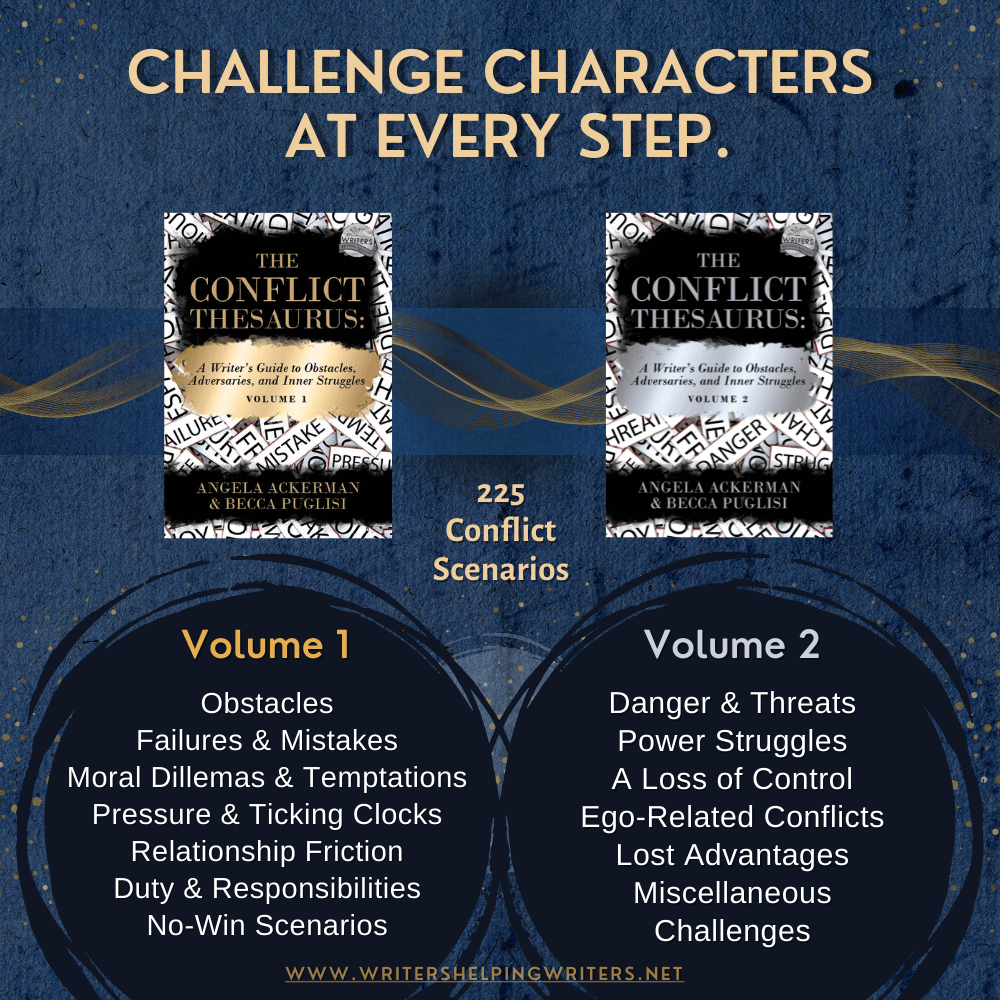
Want your conflict to go further?
The Conflict Thesaurus: A Writer’s Guide to Obstacles, Adversaries, and Inner Struggles (Volume 1 & Volume 2) explores a whopping 225 conflict scenarios that force your character to navigate power struggles, lost advantages, dangers, threats, moral dilemmas, ticking clocks, failures & mistakes, and much more!
Brainstorm the perfect story problem or challenge for your characters, pushing them to adapt and bring their A-game if they are to achieve their goal.






5 Comments.
This is great, Angela. Sharing it with a client.
Thank you for this helpful post. In my current WIP I need more conflict at the scene level. Your examples and comments will help me do this.
I’m so glad. There are so many great ways we can add conflict at the scene level. If you are ever looking for an organic source, look to the scene’s setting and the people/things/dangers/risks that are naturally found within it.
This article sure comes at the right time for me. I’ve finished the second book in a series, and it just doesn’t have the same punch as the first. I’ve struggled to figure out why. Well, I struggled until I read this article. There’s not enough scene-level conflict. The protagonist methodically goes about finding who the bad guy is and capturing him, but many of the scenes don’t contain the conflict he encounters going from one step to another. I thank you so much for sharing this information. You’ve set me on my way to making my story MUCH better.
Oh I am so glad you found this post, Henry! I love it when I trip on something just as I need it, so I hope this one helps you nail that missing element for your story!