


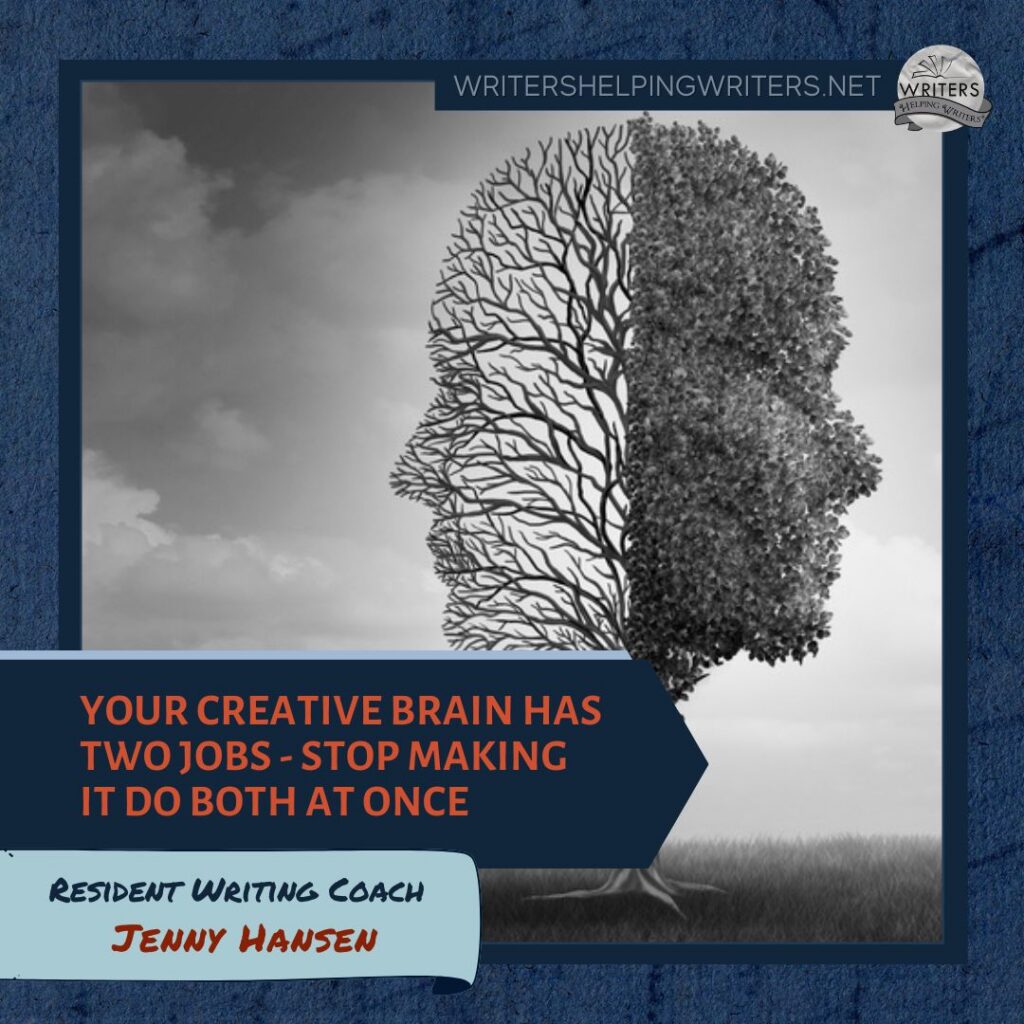
Last week, I had one of those days when my creative brain needed one of those intersection traffic cops. (You’ve seen those cool cops, right? They’ve got the cool whistle, and they look like they’re conducting a symphony.)
Nothing was actually wrong. In fact, I had too many GOOD things happening…and it was short-circuiting my ADHD brain.
- Ideas. Conversations. Opportunities.
- Things I wanted to write.
- Things I wanted to remember.
- Things I wanted to follow up on immediately before I lost “that most amazing idea forever.”
By late afternoon, my brain had responded to all this abundance in the traditional creative fashion: It wanted to do absolutely nothing.
Creative Superpowers
Creative people are idea factories. It’s one of our best superpowers. But if you’re like me, with a very busy brain, you might be sub-par at distinguishing between a great idea and I must do this great idea RIGHT NOW.
Sometimes great ideas create bad traffic jams. Because we LIKE our ideas. Great ideas are playtime for writers, and we play better than almost anyone. All those great ideas make us flex our creative superpowers like the badasses we are.
Nobody has to convince me to get excited about something shiny and new.
My brain will happily abandon the thing I’m supposed to be doing and gallop toward the new idea waving both hands in the air.
When Your Creative Brain Has Too Many Tabs Open
The problem comes when five glittery ideas show up at once. Suddenly, instead of feeling creative, I feel behind. Instead of abundance, I feel obligation. Because now all those wonderful shiny possibilities are on my dreaded to-do list.
At least 50% of the time, when my creative brain is faced with a big to-do list, it does something spectacularly unhelpful. It freezes.
Not because I have nothing to work on. But because I have seventeen things I could work on…and every single idea arrived with a decision attached to it.
Write me? Save me? Research me? Start me? Ignore me? Am I brilliant? Am I ridiculous? AM I THE ONE?
Turns out, my brain wasn’t just creating. It was creating and deciding at the same time.
(Stick with me, and I’ll explain why this is a colossally bad idea.)
Harvest First. Process Later.
When I called my coach last week, this is how she saved me, mid-spiral:
“Harvest first. Process later. You don’t need to decide what to do with every idea right now. You just need to capture it, so you can act on it later.”
I argued with her for a moment, because I didn’t truly believe I’d be able to FIND the idea later. (That was ADHD talking.)
And she then reminded me that this is what programs like Evernote and OneNote and Scrivener and Todoist are about. (And that I have and know how to use all of them.) All those programs are searchable, so you can find your shiny ideas after you’ve calmed down.

Note: One Stop for Writers is great this way too. It doesn’t allow any of your amazingness to fall through the cracks.
(But, just in case of extra amazingness, I also have a huge whiteboard in my office, to catch the big ideas before they slink away.)
Every writer MUST be able to catch ideas somewhere. We all have to pick a great place to:
- Write that idea down.
- Make a note about the character who’s knocking on your brain.
- Drop the research link somewhere you can find it.
Then back it up somewhere, in case of flood, fire, or technological kablooey.
THEN go back to what you were doing. You can decide later whether that idea deserves three months of your life.
Create Now. Decide Later.
That conversation with my coach sent me down a major rabbit hole. I wanted to know whether there was actual science behind “Harvest First. Process Later.”
Turns out, there is!
(The Science Direct link, for any other psychology people who want to geek out.)
Researchers studying what they call the “two-fold model of creativity” describe creativity as a cycle between two different jobs: generating ideas and evaluating them.
- One part of your brain is making connections and asking, What if?
- The other is deciding whether those ideas are useful, appropriate, brilliant, or destined for deletion.
Both jobs matter. But your inner editor doesn’t need to ride shotgun on every new idea. Too much evaluation, too soon, can put the brakes on creativity.
Science Says Your Inner Editor Needs to Chill
Here’s the part of the Science Direct article that made me sit up straight:
“Stringent evaluation hinders divergent thinking abilities.”
Translation for writers?
Your inner editor has an important job.
He, she or they just don’t need to show up while the creation party is still getting started.
Suddenly, my “too many good things” problem made a whole lot more sense. Every time a shiny task or idea appeared, I wasn’t simply recognizing it. I was immediately demanding that it be accompanied by a plan.
I was making it audition for its future. Worse, I was assuming everything had a future. (And yes, this is a total ADHD thing. But so many of us writers do it.)
- Is this worth my time?
- Is it better than what I’m already doing?
- Should I start it now?
- Where does it fit?
- IS THIS THE ONE?
No wonder the traffic jam got worse. I was asking “tomorrow” questions today.
My New “Radical” Experiment…
I’m turning over a new leaf for the rest of the year to see whether it leads to better productivity (and less analysis paralysis…aka freezing).
First, I create. Later, I decide. Or, as my coach put it: Harvest first. Process later.
Not every good idea gets a job. If it is interesting or brilliant enough, it will stand the test of time. (This one hurts a bit. But I am the only one working on my ideas, and there are only so many hours in a day.)
For the rest of 2026, I’m keeping this on my bathroom mirror:
An idea can be good without becoming a project.
I’m putting that here in this article, mostly because I need to read it again. An idea can be good without becoming a project.
It can sit in a searchable software program with a reminder to pop up for me in 2027. Maybe by then, it will have collided with something else and become something even better.
(Y’all heard my mid-year revolution/resolution here first!)
Evaluation isn’t the enemy. Timing is.
Our creative superpower is ideas. We love to have them, and we love to catch them.
For me, the panic comes from believing I’ll lose something.
- What if I forget it?
- What if I never have that idea again?
- What if this is THE ONE?
So, my busy brain tries to hold on to all the ideas. All. Of. Them. It’s a problem.
There’s little energy or space left for writing and all the other jobs we carry, when our mental arms are full of things we’re trying not to drop.
Sometimes writer’s block isn’t an empty well.
Sometimes it’s an overflowing well we stand in front of, trying to fill buckets, mason jars, and coffee mugs, all at the same time. The situation worsens when we try to catch all the ideas in our bare hands.
Those are the writers who are mentally screaming, “Don’t let any of it get away!”
But we have technology. We can do this… Catch the idea. Write it down. Save it. Then go back to that lovely, important task you chose to do.
Creating is one job. Deciding is another.
Harvest first. Process later.
The good ideas will still be there when you come back.
How about you? Does your creative brain freeze when you have too little to work with, or TOO MUCH? I’ll be interested to hear who saw themselves in this article. I want to hear all about it down in the comments!




1 Comment. Leave new
How do I go about covering or linking or featuring your content on my website? Please send your requirements. Authors have extended fair use conditions provided I display full attribution.